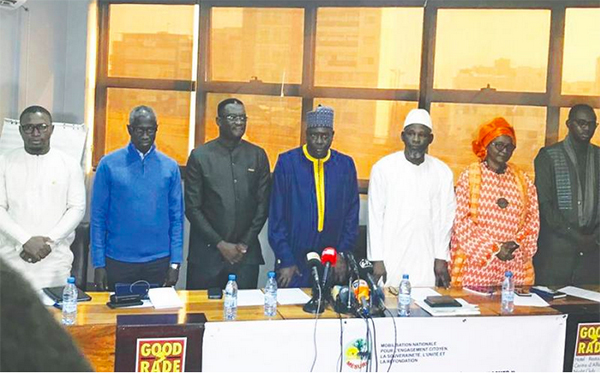
Mindful of the general interest, Senegalese civil society is calling on the government and the parliamentary majority to break the current deadlock over the vote on the 2026 supplementary budget (LFR). The bill was sent back to committee on Tuesday at the request of the Minister of the Economy.
By Dialigué FAYE – Senegalese civil society organisations have set out their position on the crisis between the Executive and the Pastef parliamentary group. In a statement, they urge the government and this parliamentary majority to break the current deadlock over the vote on the 2026 LFR. Indeed, they note, “the country needs a budget that restores the credibility of public finances, protects household purchasing power and strengthens transparency, without sacrificing the future.
Senegal does not need a tug-of-war between the Executive and the Assembly that delays decisions, undermines trust and exacerbates austerity and the suffering of Senegalese people”.
Civil society is therefore calling “for a dialogue between institutions based on official budget documents and verified figures, with input from independent experts and citizens’ organisations. For the interests of Senegalese people demand a compromise that guarantees the continuity of the State, social justice and accountability”.
It does, however, support “the demand for clear and effective oversight of special funds. The issues surrounding these appropriations, which concern Senegalese taxpayers’ money, require a legal framework allowing genuine parliamentary scrutiny, while respecting the balance of powers.
This reform must be adopted by consensus, in accordance with the Constitution”.
In the face of the energy shock, the CSOs believe that “the State must avoid sudden increases that hit low-income households, transport and food products first”. That is why they argue that “subsidies should gradually be better targeted towards poor households, public transport and essential social sectors, rather than remaining largely across the board”. To that end, they ask that “any adjustment be accompanied by a verifiable strengthening of social safety nets, in particular family security grants. Cuts to education, vocational training and social solidarity must be avoided or offset”.
They also stress that “the debt situation and the agreement with the IMF are now a government choice requiring parliamentary and civic oversight and monitoring, so that the burden of the debt-restructuring effort is not borne by households alone. Consolidation cannot be achieved solely through cuts in investment without transparency on the selection criteria. Projects with a strong social and economic impact (agriculture, electrification, health, education) must be preserved as far as possible. Revenue must be realistic and spending clearly prioritised”.
The citizens’ organisations remain vigilant over budget execution, the quality of spending and the protection of households. They urge “political actors to put the general interest above partisan political calculations”. They also encourage “a rapprochement between the positions of the government and the parliamentary majority through the adoption of the necessary amendments, so as to avoid the rejection of the 2026 LFR and the 2027 Lfi, and recourse to exceptional procedures that could undermine the sound and transparent execution of the budget for the sole benefit of Senegalese citizens”. As a reminder, the Plfr was sent back to committee on Tuesday at the request of the Minister of the Economy.
Comments (0)
Be the first to comment.
Sign in to comment